
Philly Crit Takes on Drew Zimmerman
May 10, 2026, at the Pennsylvania Academy of the Fine Arts
Philly Crit is a program conducted by faculty members of the Pennsylvania Academy of Fine Arts that gives artists an opportunity to receive critical feedback on their work from a large group of their peers.
Drew Zimmerman: First off, I subscribe to the idea—it’s not an idea, it’s true—that the least important thing about a work of art is the intention of the artist. So, what I’m asking for is basically a cold read, but I would describe that as, “How do you apprehend these works?" You don’t necessarily have to say what it means, but what are the pieces and how do you put them
together? How do you perceive the work?
Peer 1: I feel like everything jumps out as a trigger for remembering something from other ages.
DZ: I find that inevitable. We heard it being referenced by the last artist we saw. Unlike saying
that I’m living with spirits in the room, right now, I am living with all the historical connotations
that created every person in this class. If you look [at the art hanging] around the room, the distinction [between all the individual artists and their work] is the most salient quality of a work of art: the hand of the artist. As you say, these obsessions of mine, mostly the constructs, the way the picture’s put
together, that’s the hand of the artist for me, and I appreciate that it’s indelible, and artists, at
least the ones who have succeeded in finding what they’re doing, have a visible look that’s
instantly identifiable. I don’t know how you would explain that look, how you could account for it,
or how you would explain it to someone else.
So, to the degree that I’m sensitive that not all of the content of my work is visible, I know that [a
distinct] visual element exists, and that it’s inevitable makes it precious to me.
He said.
Rita: My first impression is board games.
Albert: Hah!
DZ: I like that.
Rita: There’s a background, you know, a board. And then all these moving parts around it.
Maybe we’re similar ages, but it calls to mind that. Things are happening–the dynamic, so um..
DZ: I think this is the one you’re thinking of–doesn’t this look like Candy Manor, or whatever that
was, the board game that was just colors, to march around the board.
Rita: I didn’t play that.
DZ: I didn’t either.. Boring.
Rita: Actually, the ones with the sort of snaky thing like shapes.

DZ: Yeah.
Rita: And then look at this one…it’s making all sort of references that I sort of recognize from
childhood and putting them together in a way they never did go together.
Childhood…dreamlike.. or another word..nostalgic. Another thing…
DZ: Right. Right. If you look at the script here..and there’s no reason you would..it’s an outside
content from what the pictures are. I am creating an artificial depth in text with the
narratives..and I think all narratives are artificial.
This is a rebus. Ok? Which is a pictogram. And
going into nostalgia, I remember the TV game show Concentration, where you have to solve a
rebus. But the thing is, rebuses are 40000 years old. They are the last thing before we invented
alphabets. Sumerians had it. Each of these represents a phoneme, not the picture that it is. Part
of the content is that the picture at least coincides with something that isn’t pictorial.
Rita: It invokes something that isn’t in the picture.
DZ: Right, and what you said about the imagery: I did grow up in the 60s when what Warhol
was doing with Brillo boxes seemed perfectly adequate. Or what Rauschenberg did with silk
screen. It’s the cacophony of images. And alternately, this has a subtext.
Let me solve this for you, since no one can tell me what the tag says.
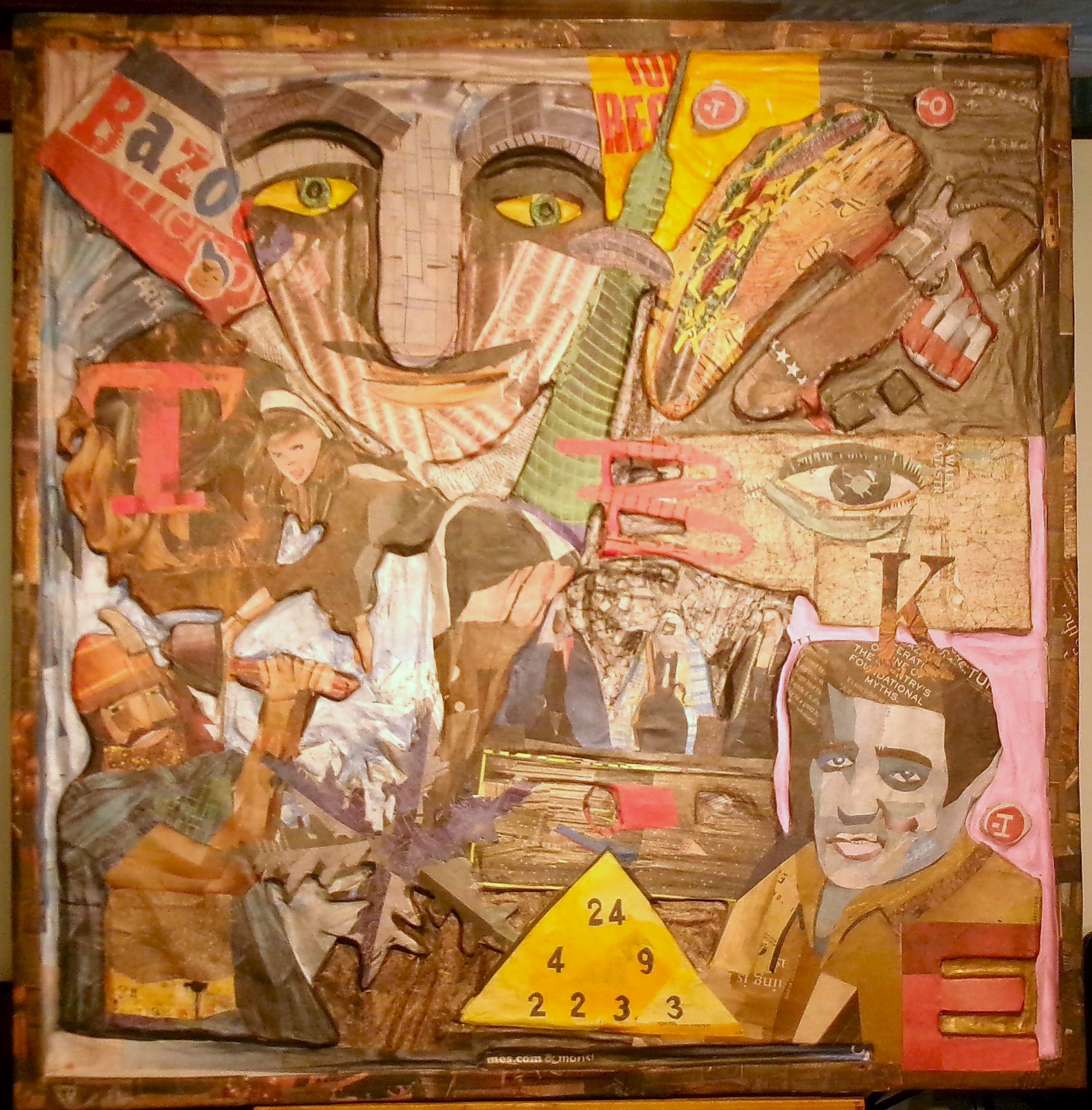
This is Bazooka Gum. Now that’s nostalgia because Bazooka Gum told fortunes. Here it stands
for “Come.” and I’ll just point to the pictures and tell you what the phonemes are. If you do it in
your head, everything is there. “Come Mask." This is Tower Records and a Tower, so it’s
“towers.” Come ask our stock holders. "Taco Holsters." "They're." T and Hair. This is a "Maid." There’s
a “B” and an "Eye": by. “Magi.” The three magi are here. I was especially proud of that. With the
letter “K” that would be magic. “Elvis.” The 'I' taken out is “Elves.” So far we have: “Come, ask our
stockholders, they’re made by magic elves.” “Sand.” “Thor.” “Snow.” “Factor.” “E.” So, it’s the old
Keebler motto: “They’re made by magic elves, and there's no factory.” “Come ask our
stockholders.”
[Applause]
So, uh, that’s the insidious subtext in the picture. I don’t know if anyone solved it when we were
walking around [audience laughter] but obviously—literally—the subtext is hidden. We don’t look for it.
Connor: I believe you said the least important thing about art is the intention.
DZ: That’s Jorge Luis Borges and several others.
Peer 3: You have a helluva lot of intention.
[laughter]
DZ: And it’s the least important part.
Peer 3: Just because an image could be solved, is there a takeaway that the viewer could have
without solving it?
DZ: Ok. Sure. The solution is fascist. That’s Donald Fagen. He didn’t like music videos. The
solution is fascist. So, if I tell you what these mean, that’s fascist. But on the other hand, the
text is literally woven into the piece. Science Project is one piece, the text is there. In a sense
that’s a concrete thing, the way a solution is concrete. But art isn’t concrete. So, if you take the
pieces, what do you think of? We heard a lot of explanations, people explaining their experience
looking at pictures.
One thing, there is no portrayal of movement. I don’t care what we think Nude Descending a
Staircase looks like. Duchamp was very aware he was just working with paint. There’s no
movement in any painting. There’s movement in Calder, not in paintings. Calder, not paint. Here,
the movement isn’t physical, but it’s explicitly in the context. You [follow] the words in a sentence
in this one.. Here, you have a shape with text woven into it. I put the text on those qr codes if
you want to see it.
These Rube Goldberg pieces explicitly have movement in them. They’re
lettered for your convenience. And it takes you through the work. The artificiality is what
interests me because…

We talk all the time about narratives. All narratives are false, all of them because…the past that
we use to build our narratives doesn’t exist. It’s a complete abstraction. And my memory of what
happened is totally different from yours. I could never put anybody together in this audience
from the pieces. That mystery always exists.
And the movement through these is false. The pictures have words and letters in it and you read
a sentence from left to right, but you can see that’s just a construction. It’s not literally true. I
notice when people look at these pictures, they're not looking at the text. And that’s cool, too.
Peer 3: Within the mythology of your creations there may be some disconnect with the inherent
meaning based upon the timeframe of existence, so some of the signifiers would be dated to
somebody who’s not aware what they mean, so how important is it to you that somebody figures out your false
narrative?
DZ: I think of ‘all narratives are false’ as a reference to physical fact; it’s a literal narrative when
I’m reading it. All narratives are false. I take it for granted that other people don’t see what I see.
I’m hoping for the idea of… Well, look: [gesturing to other work at the crit] all this other work is explicitly visual. Mine is explicitly not, although it has a visual element. I’m interested in presenting a different work, where the frame isn’t exactly on the wall.
Emily: I was also thinking about, “Is your intention to get people to maybe sit with the work and
try to maybe go deeper into the text?” Seeing all of these things, you know that these other
works are mostly visual. Did you know people stop for seven seconds to look at a picture in a
museum. Is there some way you could frame the work to let us know that there is something we
should be looking farther for? Because I’m a person walking in a gallery, I’m going to look at the
work visually and putting these Icons together, I’m not thinking necessarily of figuring out a turn
of phrase.
DZ: Sure. Yeah. Especially in this group. Somebody mentioned Duchamp. Taken as is it's a bicycle wheel mounted on a chair. Clearly he means something else for it and it isn’t present in the frame. That’s the tradition I’m working in. As far as
what I expect people to do– Nothing. I have no expectations, and I don’t do my work for what’s
going to happen after I make it, for instance, the biggest version of that is money, you know?
How much can I sell this for? I think that’s irrelevant. I don’t think of that.
Albert: Actually, I want to speak to Emily’s point and that’s it’s not so much, to me, that there’s a
puzzle here or kind of…I would call it a wild goose chase.
DZ: It is. It’s explicitly so.
Albert: It’s an absurdist task, you know what I mean…
DZ: Yeah.
Albert: It’s like rolling a rock uphill, I mean like…
DZ: “Sisyphian” is what you’re looking for there.
Albert: Yup. Camus, right? What is meaningful is, one, you put us on a wild goose chase. And
you’re the type of person deriving purpose doing that. Can I ask you to speak to your will to
games and to play with us?
DZ: I say that all narratives are false. That should be shocking, because we all have narratives
about ourselves. I saw a great one in the paper. They arrested a drug dealer. He said, “After my
NBA dreams were crushed, I turned to a life of crime.” I don’t think that’s the whole story, but that’s what he’s living by.
I’ll give you an example of what you’re saying. Dark matter is a concept in physics where to
balance out the forces that are causing the universe to expand there must be something we
can’t measure empirically holding everything together.  So, here is science saying there’s
something really important that we can’t find empirically. That is so contradictory. So I invented
events that have gravity that are holding the whole world together. One of them is this, where it’s
Castro giving the first killifish trophy to Ernest Hemingway. I think it was the other way around. It
was Hemingway’s marlin fishing thing and Castro got the first trophy. This one, is Charles
Bukowski complaining that “Hemingway thought the CIA was chasing him, and I was the only
one who believed him.” Bukowski says that. This is about a character in Malcolm Lowry’s Under
the Volcano who mentions somebody who gives up Hemingway to the fascists. None of those
events affect anybody–except me! I think they’re really important. And as far as the connotations
by which I am living my life, it’s perfectly natural my reality busts through a picture by the
primitive artist..Finster. What’s his name? Howard Finster. And this part says, “Howard Finster
makes a lattice that protects the Earth from blood and fire. We don’t know which because it
didn’t really happen." Right?
So, here is science saying there’s
something really important that we can’t find empirically. That is so contradictory. So I invented
events that have gravity that are holding the whole world together. One of them is this, where it’s
Castro giving the first killifish trophy to Ernest Hemingway. I think it was the other way around. It
was Hemingway’s marlin fishing thing and Castro got the first trophy. This one, is Charles
Bukowski complaining that “Hemingway thought the CIA was chasing him, and I was the only
one who believed him.” Bukowski says that. This is about a character in Malcolm Lowry’s Under
the Volcano who mentions somebody who gives up Hemingway to the fascists. None of those
events affect anybody–except me! I think they’re really important. And as far as the connotations
by which I am living my life, it’s perfectly natural my reality busts through a picture by the
primitive artist..Finster. What’s his name? Howard Finster. And this part says, “Howard Finster
makes a lattice that protects the Earth from blood and fire. We don’t know which because it
didn’t really happen." Right?
So, yeah, in my life there’s a gravity to occurrences that no one else shares. How’m I supposed
to communicate that to you? This is my problem.
I have others.
Connor: One of the first really important paintings that Richard Tubb made when moving to New
York he began by writing a quote down by a philosopher on an empty canvas, a blank canvas,
and painting over it completely. To the point where no one knows what he put down, and I
wonder if you would find it interesting and constructive in your own work to consider how the
meaning of that action would change depending on what text was written.
DZ: Well, if it was invisible, none. Except to the artist, you know? I would never take them out of
the house if the only thing that inter.. Intrested me..interst..whatever..me was my reaction. I’m here
because I honestly do long to have people talk about these things, and I perfectly accept that
they don’t know what the hidden stuff was under the paint, and I don’t think that would change.
I’ll tell you a quote that is under all of these: Charles Mingus was talking to a guy in the
orchestra, in his band and they’re talking about Duke Ellington versus Be-bop, and Mingus–who
when he got angry once pulled the whole chords out of a piano because he didn’t think
someone was playing well enough–and he said, “There’s only one time. There’s only one music.
There’s only one genre." I think that’s true, because everything besides this moment is
inscrutable, not available to our senses. In fact, everything is hidden. For me most of all, what
made me me is hidden. I can’t do the math for that on how I got here.
James: I’m curious at how this gentleman behind you who appears to be in a car fits in with the
other…
DZ: Well, all of these works have a visual content we haven’t talked about yet. 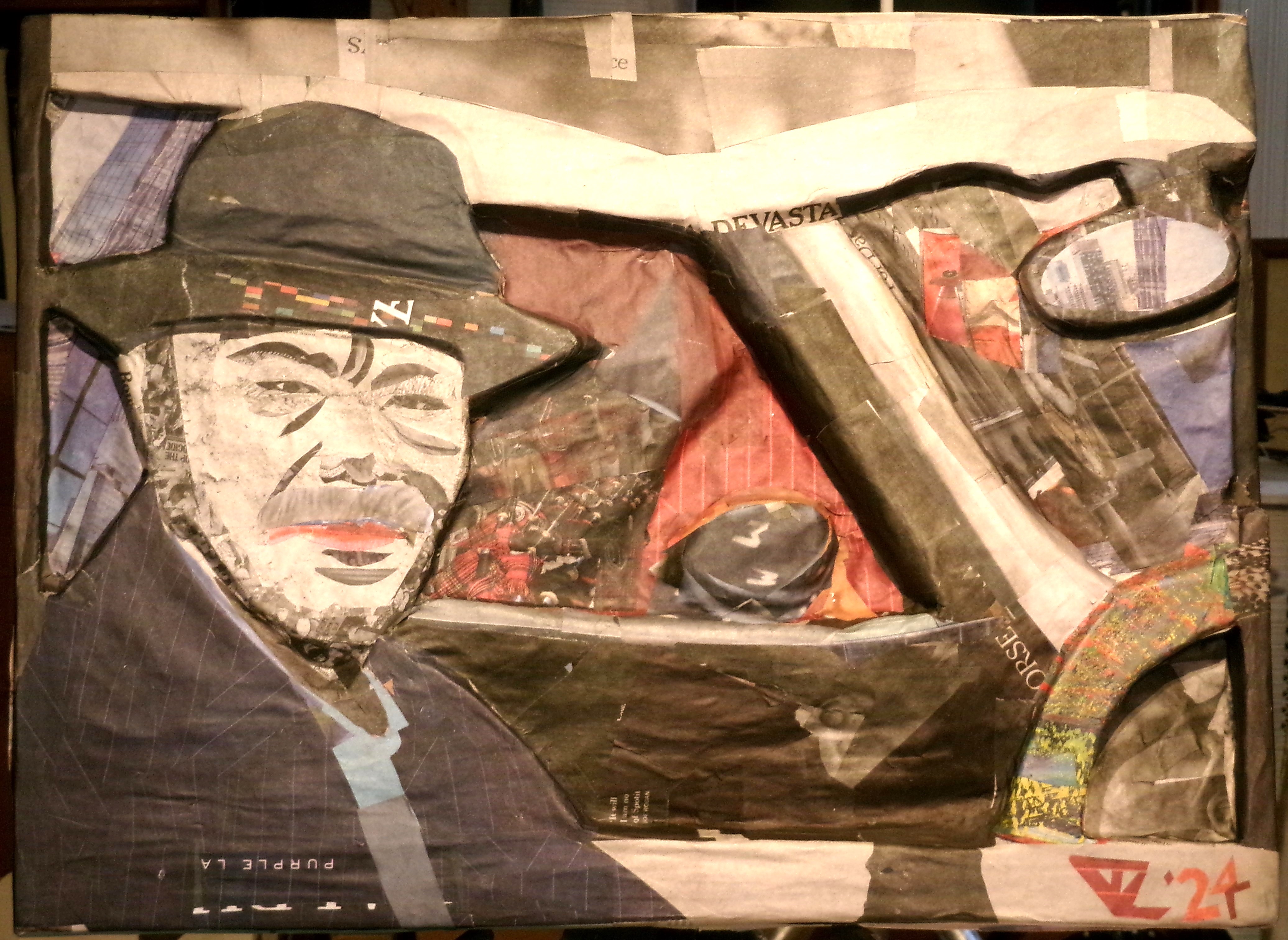 All these pieces
are essentially collage of newspaper ads. Nothing here was done with a brush. I think that’s
obvious. And this (Self-Portrait 2024), since I was trying to make a likeness, changes the whole
thing. This is more about the paper strips. The thing that I’m trying to do with this collage is pick
pieces of paper that actually… You know, there’s such a thing as transparency, but there’s also
newspaper transparency. Aspects of the print effect transparency, and those kinds of paper are interesting to apply as if they were a single color.
All these pieces
are essentially collage of newspaper ads. Nothing here was done with a brush. I think that’s
obvious. And this (Self-Portrait 2024), since I was trying to make a likeness, changes the whole
thing. This is more about the paper strips. The thing that I’m trying to do with this collage is pick
pieces of paper that actually… You know, there’s such a thing as transparency, but there’s also
newspaper transparency. Aspects of the print effect transparency, and those kinds of paper are interesting to apply as if they were a single color.
These [different kinds of] pictures here are all made with newspaper advertising but I’m more
interested in “this is the red pile and this is the blue pile.” It’s harder to do a work like this
[portrait], since a feature of my work is they’re all made of newsprint and I don’t hold a brush.
[The portrait is] the biggest exemplar of it. It’s relationship to the rest is purely physical.
Cathy: Purely visual, there are a number of things in [Magic Elves] that are really working for me
in terms of the way my eyes move around. You have, first of all, the color palette, having like
that pinky purple down on the lower left and the yellow triangle..
DZ: Well, [the paper used is a reproduction of] Klimt.
Cathy: No, the center…
DX: I’m just bragging.
Cathy: But I feel like there’re a bunch of tensions in this one, and this is just a personal thing, I
like tensions.
DZ: If it helps, I’m nervous as hell.
Cathy: You’re creating different spaces around the images so my eye can move from “Bazooka”
to the “B” to the ”E.” I can move around because of the kind of space you have in the blues and
whites on the left and then over to the pinky purple. I feel like this has many trails to bring my
eye through it.
DZ: I appreciate that. Thank you.
Cathy: Yeah, and I think that’s happening in this one in a way that I would like to see more in the
others. There’s more uniformity in the background of these [others], but [Magic Elves] as a pure
painting gives it a dynamism, I think.
DZ: I agree with your take on this painting as opposed to the others.
Sam: My name is Sam. I’m sorry, Cathy, I disagree with Cathy. So, while I have been listening to
you talk about everything, and yes you have this, what did you call it, absurdist play within the
narrative of all these pieces, right? But with how much you’re talking about, all of the information
inside these pieces, it does seem really important to you for everyone to figure out the story.
And these two on the top, they seem more inviting. When I was looking at the pieces up close, I
was drawn to all this texture and how you put the little pieces together. And the wasp nest in the
one all the way over on the right, and like, figuring out the materiality, that was the invitation for
me.Like into the piece itself and the narrative behind it. Whereas, the piece on the left is so
visually overwhelming to me that I didn't investigate further at all.
to
you talk about everything, and yes you have this, what did you call it, absurdist play within the
narrative of all these pieces, right? But with how much you’re talking about, all of the information
inside these pieces, it does seem really important to you for everyone to figure out the story.
And these two on the top, they seem more inviting. When I was looking at the pieces up close, I
was drawn to all this texture and how you put the little pieces together. And the wasp nest in the
one all the way over on the right, and like, figuring out the materiality, that was the invitation for
me.Like into the piece itself and the narrative behind it. Whereas, the piece on the left is so
visually overwhelming to me that I didn't investigate further at all.
DZ: (giggles)
Sam: And like that one, you spent so much time talking about the little microdetails that feed into
the larger story and all the things going on in your head and the different pieces that are
connected to you during your life that are embedded into all of these pieces. So, I like wonder if
there’s a balance within that for people like Cathy who are more acclimated to that and people
like me who are more visually geared towards [that other kind.]
DZ: I’m not sure…
Sam: I just think there’s maybe a disagreement between what you’re saying out loud versus
what is actually [garbled].
DZ: There’s explicitly a disagreement between what I think it is and what you think it is.
Sam: No, I don’t necessarily…that’s not what my intent is. I’m saying that you’re saying it is not
important to you that we figure out what the narrative is, but you take so much time telling us the
narrative.
DZ: I don’t take myself seriously. I don’t take my desires seriously. I don’t take my narrative
seriously. Least of all… Well, not least of all... There’s nothing precious about my art. That’s why
it’s made of paper, that’s why it’s on insulation board. I think it’s cool as hell. I think all of you
should, too. But I don’t have any hope that will happen.
Sara: There’s something that I.. It’s interesting to me conceptually that I think is coming out of
this is a larger conversation about Art in general. The paradox of being someone who’s
incredibly complex, as everyone in this room is, and wanting to communicate something which
by definition is incommunicable because it’s like the entire existence of our consciousness. It’s
like sort of why we’re all doing this ridiculous thing. Like, how do I create something that is some
attempt to communicate something that most of us don’t talk about throughout our day-to-day
surface-level conversation which is like “How fucking weird and complex is all this?” So, like,
your work really does push this paradox that I don’t believe that anyone will understand what’s
inside me, and something in me is still trying. There’s something, that was my experience as a
viewer. I was looking at this, I was like, “I have no idea exactly what the fuck is happening, but
I’m very curious about it. It helps me reflect on the place in me that thinks about “what the fuck?”
So I just want to say, on that level it’s working.
DZ: My intention is unimportant. This woman knows what I’m doing.
[Applause]
DZ: Thank you all. I really appreciate it. We’re here all week.