
Muse Gallery's 36th Anniversary Show
Philadelphia's oldest artists' co-operative gallery celebrates its longevity every December with a group show. Because they have successfully and democratically responded to stress in their environment for so long, Muse Gallery has much to celebrate. I admit my favorable bias in that I was a member of Muse Gallery until fall of 2013 (and its director for 18 months), but here then is first-hand witness to the amazingly vital functioning of the organization. Name me another endeavor of equal complexity managed entirely by collaborating artists? Hell, even the Traveling Wilburys folded eventually.
One skill that stays razor sharp in a group like Muse is hanging a show. Someone always volunteers to do it, gets three others to form a committee, and has the gallery ready for First Friday traffic before you can say, "I'll bring the cheese." When twenty or so artists are each showing one or two pieces, an affinity of colors, shapes, and textures guides their arrangement, and visitors especially appreciate a straight categorization according to non-verbal cues. Kathryn Lee's paper collages Blue Engine and Red Engine, so bright and warm, looked splendid in the back of the space next to Deann Mills' large abstract, I'm Busy. Ms. Lee, a former book illustrator, always exhibits the most marvelous, colorful constructions in three dimensions, compositions of purely abstract forms mixed with references to actual objects. Sometimes she mixes her own colors and paints paper stock, and other times she uses already colored papers, twisting and folding them to make forms that stand out from the white mounting board.
I often see purely abstract work that makes me think the artist has exhausted his vocabulary of shapes. 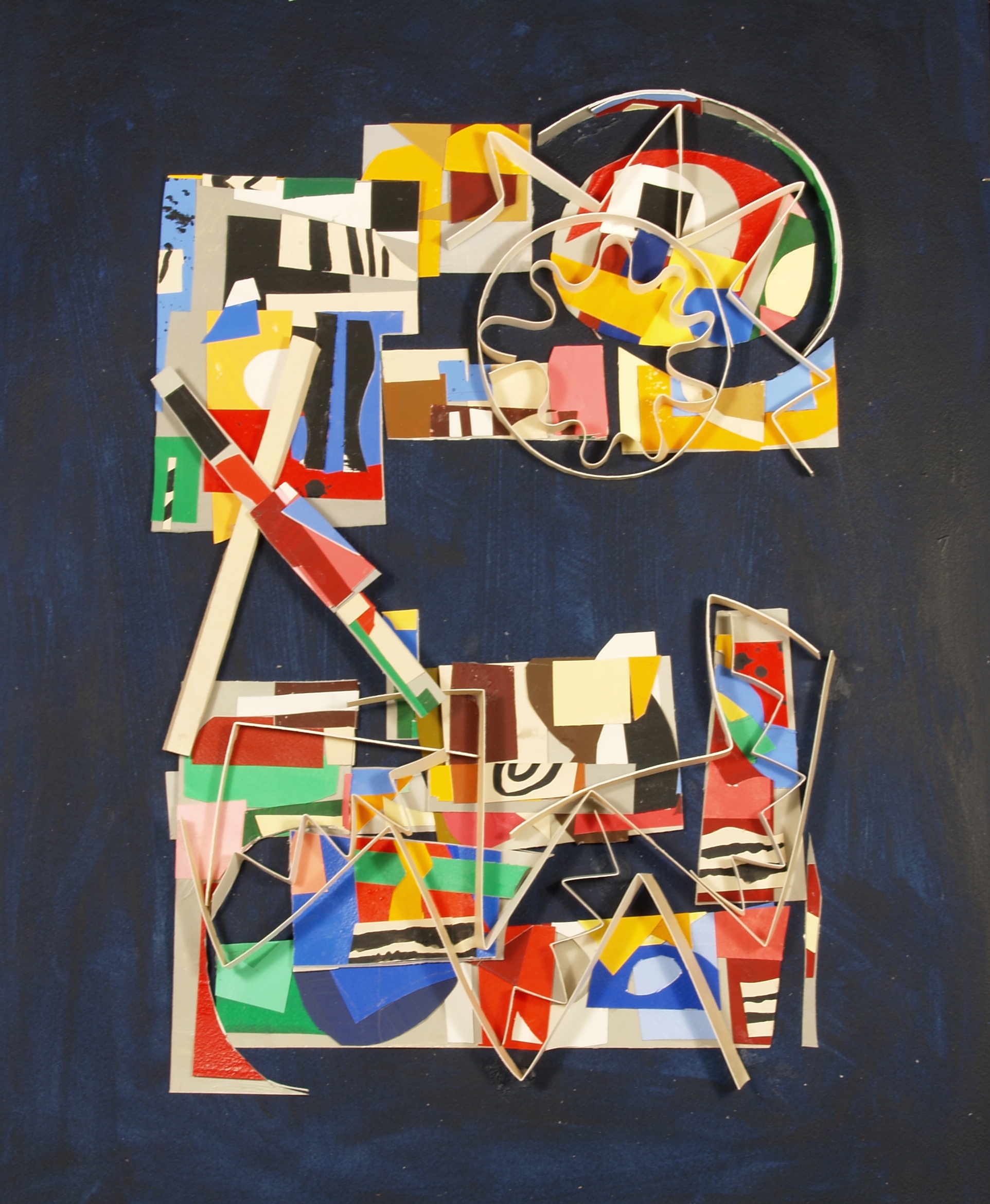 By now, I've seen more than fifty of Ms. Lee's works, and she is as inventive as Sheherazade and always gives me the feeling that the party will go on forever. Deann Mills, who works in oil on large canvases, is another primarily abstract artist whose creativity with brushed forms, brilliant colors, and composition expresses the free energy of paint without the ennui of a large segment of 21st century art. Deann's previous life was as an architect, and I think she builds her work with great care so that each section works compatibly with the whole. The painting in the anniversary group show may be designed to answer the question, does Ms. Mills' painting have too much in it, too many colors and forms fighting for space? The answer is not that the painting is overstuffed, but rather that the artist herself contains many interests and passions.
The sculptor Etta Winigrad has been with Muse Gallery longer than any member artist except Lorraine Raywood, the resident mixed media and photography wizard. They remember when the gallery was a women-only collaborative. Ms. Winigrad's ceramic work follows a process of her own adaption where, in the final phase, the raw clay is exposed in the kiln to various burning woods for the effect the smoke creates on the crystallizing surface. More amazing than that is Ms. Winigrad's quirky extrapolation from the human form that is at once innocent, a bit primitive, and endearingly expressive.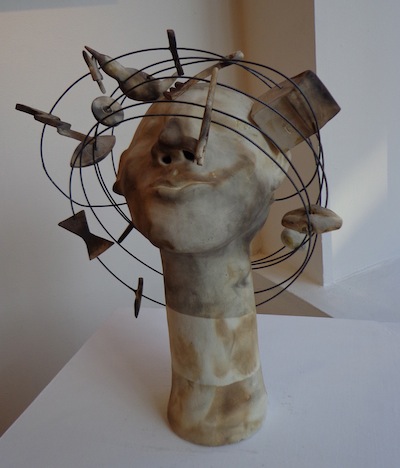 Around and Around makes material a head filled with too many ideas and things simultaneously. In a halo circling his brow, a key, furniture, sporting equipment, a lightning bolt and other Monopoly-set tokens represent a churning of consciousness. The skill with which the work is assembled and realized can't be overstated in the case of this superbly refined professional whose sophisticated sculpture always maintains a childlike grace.
In contrast to Ms. Winigrad, the printmaker Terri Friedkin has been a member of Muse Gallery for less than a year, but like her colleague, she creates her own path. The last prints I saw by this artist had a texture suggestive of computerized typing; in Unleashed she uses an array of perforations in a block of color that reminds me of modern building materials or even Ben-Day printing dots, but in any case they're human artifacts rather than forms from nature. Ms. Friedkin suggests a lot with very little. I wonder if the windows-like forms of Mark Rothko influenced the composition in this anniversary exhibition. She shares that artist's skill at creating transparent panes of color and the endless permutations to be gained by overlapping them.
Sara Bakken's three-dimensional Environment is made of silk organza and glass, and, once again with these Muse Gallery types, she is applying her own process to the materials. Ms. Bakken distresses the silk with heat to make nodes and uses hand-blown, often sand-blasted, glass to complete the delicate forms. Frankly, I have no idea how she holds the sections together: is it done with string? surface tension? centrifugal force? In the past, her work has studied simple organisms that live in very deep seas, and the work in this show also celebrates nature's elegantly abstract forms dwelling in that part of creation most alien to man.
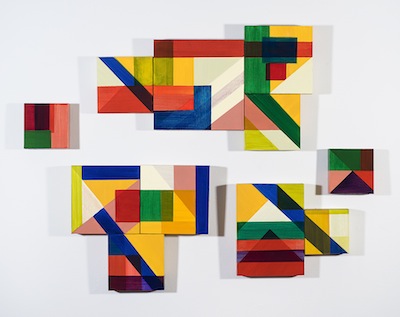 Diane Lachman is a professor of color. I'm not making that up or being hyperbolic. She taught in the University of Pennsylvania's fine arts program, but retired when they made color an elective course for undergrad artists. (The same damn-the-foundations-let's-build-a-house enthusiasm has erased grammar from every college English program I know.) Ms. Lachman's canvases have always been about the juxtaposition of different hues and tones, and her compositions have featured abstract arrangements of grid-like boxes or floating lozenges.
Warp and Weft continues a series from her last Muse exhibition in which the picture grid breaks into pieces, not like a jigsaw puzzle, but like some four-dimensional, geometric construct that requires special technology to be expressed in our visible three. The artist provides a separate schematic with each piece that spells out precisely how the parts of the whole should be displayed on a wall. In my experience with Muse Gallery artists, Ms. Lachman's resourceful and inventive approach to realizing a personal vision is very much the norm. Perhaps the quality that best predicts membership in this co-operative isn't frustration with the commercial gallery scene in Philadelphia, but a wholly individual approach to the use of familiar materials.
©Drew Zimmerman, 2026