
Susan Mckee: The Invisible Superficial
Sometime in Art's murky past, the subjective world view triumphed over the public version (don't worry-- there'll be a rematch), and since then, painters have represented the hopelessly individual nature of experience with various technical schemes. The adjacent application of complimentary primary colors in Impressionism refers to Newton's work on optics and the idea that a viewer actually mixes colors in his or her brain; the grids and fragments of Cubism are a reaction to the falsity of imposing a single, physical perspective on that same viewer. Ironically, artists relied on color systems and prescribed techniques to expose a fundamental truth about experience: that it is by nature unpredictable, unsystematic, and wholly susceptible to the irregularities of an individual observer.
I'm not condemning Seurat or Braque for their inconsistencies because every plan to depict reality is equally doomed. Magritte's "This is not a pipe" seems to me the only irrefutable utterance in art criticism. In a discussion of painting, one must accept the existence of any number of technical metaphors for the ineffable object depicted within the frame and accept that a representation of the real is not reality. The very best we can hope for from a painter is a thoughtful, stylish projection of their own faculties in reference to a mutual, but misunderstood, multiverse. (I know you're out there: I can hear you writhing.) Disregarding all that tautological drek about art for art's sake and painting about painting, every art work is ultimately about the person who painted it. We look at their work and compare our own experience of the world to the artist's. And then, we plan lunch or pack the car, however we interpret new information. Painter by painter, it takes years of painstaking work to acquire a mere simulacrum of all that stuff out there, but, oh, the people you meet, the places you go!
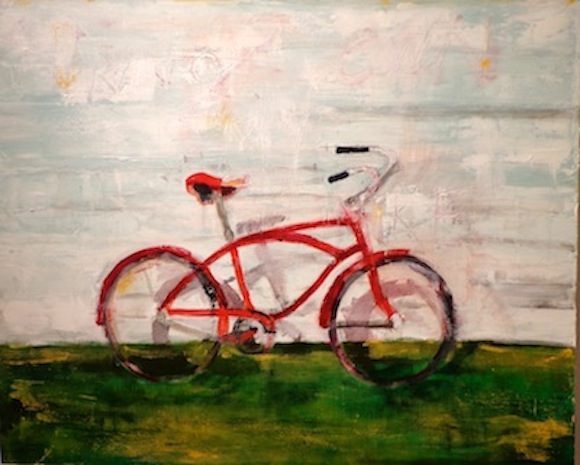
Susan McKee's current [January, 2014] show at Muse Gallery conveys a quirky and often lonely version of existence through offbeat subject choices and the artist's expressive brushwork. She calls the collection of bright canvases Glimpses, indicating the impossibility of presenting a comprehensive record of that which is viewed. We are inside Plato's cave, people, inferring a leafy, sun-dappled outside that may only be understood secondhand. Ms. McKee knows no better than you or me how to interpret life's phenomena, but she's a valuable witness with a tone that's humble and humorous and common-sense insecure.
A man toolless or a tool manless--Take your pick!-- signifies the condition of futility and unfulfilled purpose into which we have awakened. For instance, one of Ms. McKee's paintings abstracts the Maytag guy from those iconic television commercials featuring the "loneliest man in town." Clearly, every worthwhile artistic career is similar to that of the isolated repairperson, possessing a wealth of skills in vain, since Truth and Nature will never yield to them. The painting Bring Your Own Bike describes an abandoned, red, two-wheeler, leaning against a weathered facade, a perfect expression of some absent "other" and more than that, a delightful means with its cause deleted. McKee incises the painting's title into a colorless layer, graffiti in the whitewash. She's adept at producing transparent layers of paint that give the work a gauzy atmosphere, a fog over the proceedings, a technical means to express a wistful nostalgia, the persistence of loneliness, and the weakness of memory.br>
Glimpses contains shots of pretty women, the white vinyl, 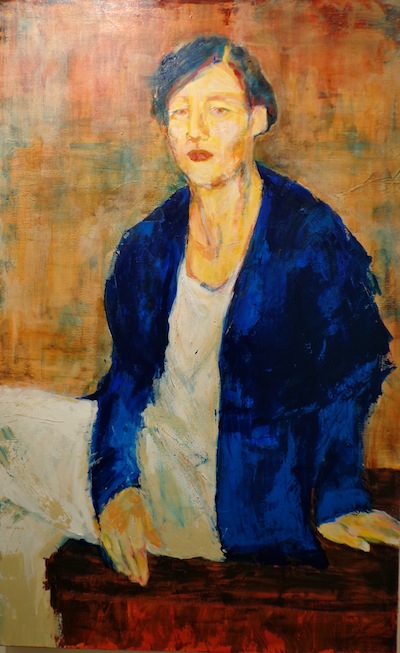 knee-high boots of a drum cadet and a row of leggy babes under globular hair dryers. Ms. McKee's subjects and titles (Soldier Boy, Sweater Girl, Maytag Repair Man) fix her in a particular generational cohort, so we can see her coming. The banal familiarity provides a comfort zone so she can do something truly subversive, which is to use a technical mastery of her materials to suggest what she does not have and can not acquire.
As avarice is the refuge of the stupid man, and religion is a balm for the uneducated, art is control for the helpless. McKee in charge! The woman in Sweater Girl is strikingly beautiful and engaging, but the artist doesn't fuss over the details. The sweater is a lush, deep, wool-knit blue and the woman sits transgressively on the side of a table. She leans toward us with an "It's your move!" expression. The paint here is a patchwork of opaque and transparent sections blending depth of rendition with a purposefully superficial eye. Memory is inexact. It has lapses. Boy, does it have lapses.
This artist, Susan McKee, in this show at Muse Gallery, is a virtuoso of presenting the limits on perception. She probably wasn't thinking about Immanuel Kant's bicycle when she painted the postcard shot for Glimpses." Kant argued that we never actually see the quality of bikeness, but we have it in our heads, an image suggesting every aspect of the subject. Great! So now I have that going for me. But this a priori bicycle we see is not the thing itself. Our view is too particular, fixed, shaped by our own random experience to truly encompass the whole. We make do, but the human condition is essentially an anxious exile to five senses. Shouldn't there be more? And where's my jet-pack?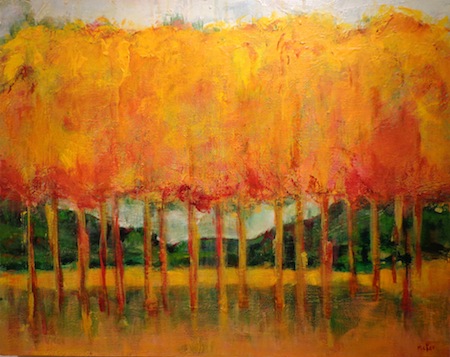
I love the side-by-side pictures of the Wicked Witch of the West getting in Dorothy's face and a row of trees McKee calls Out of the Woods. The witch's hands are clawing, grasping against Margaret Hamilton's chest, there, and little Judy looks up at her, helpless. But the child's expression isn't fear, exactly: it's more a look of nonplussed anxiousness. The danger our witch represents kicks in against us only if we engage it.
Thus, the trees in Out of the Woods are a row or two deep, a barrier in the sense that those padded contraptions on a football practice field are barriers. They only impose themselves if one takes up the sport. McKee allows that she suffers a sort of self-imposed anxiety that's part and parcel of choosing to make art, exerting self-limited control over an environment she can see but dimly.
©Drew Zimmerman, 2026