
LOVING LADY ASHLEY AND NOT BEING AN ASS ABOUT IT
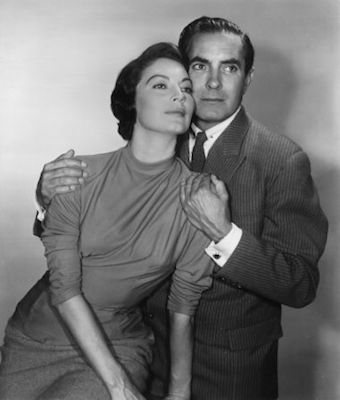 At left: Tyrone Power and Ava Gardner played Jake and Brett in the 1957 film of The Sun Also Rises
Several, non-sequential pages of The Sun Also Rises are given over to descriptions of Paris taxi rides. Jake takes a few and he enjoys telling the reader the order of the streets and the strings of shops and cafes on the route. Stripped of the significance they may have held for a very brief period in 1920, lists of place names that not only mean nothing to me, but also, I dare say, have no particular meaning to the average modern Parisian are like the Dada poem Gadji beri bimba by Hugo Ball and made into the song, “I Zimbra,” by Talking Heads. Their minds wrecked by The Great War, artists who identified with Dadaists and Ball (who wrote their 1916 manifesto) intended to winnow the meaning from human speech, leaving only the fractured sounds of the phonemes. The manifesto explains, “With these sound poems we should renounce language, devastated and made impossible by journalism. We should withdraw into the innermost alchemy of the word…”
Dada rejected reason since it was with lying reason mankind had justified the pointless murder of millions across Europe. Journalism, Jake Barnes’ profession and the tool of opinion makers, was the deceptive practice of reporting empirical facts in such a way as to compel the reader to draw specific conclusions about them. We know from Ecclesiastes, however, that it is human vanity to impose meaning on the ineffable slaughter and feverish confusion of God’s creation. As narrator, Jake Barnes takes pains to present certain events that occurred over a six-month period without presuming to tell us what these events mean. Story itself, with its important causes and decisive battles, is a great vanity.
If Hemingway’s The Sun Also Rises were a caper thriller featuring a bank heist, there’d be a scene where the thieves carefully dissect Robert Cohn’s self-pitying binge after Lady Ashley dumps him in San Sebastián, but this story never reaches for the electronic chalk. Cohn’s gloom clashes with the ritual pleasures of the Festival of San Fermin. Wherever Cohn and the other Americans settle themselves, a row erupts thanks to the impossibility of managing all the hurt feelings and strained friendships. Robert Cohn’s falling in love with Lady Brett Ashley creates an unmannerly interruption of a cheerful, but controlled routine, cultivated by Jake Barnes and his friends, to drunkenly celebrate the gift of life and the sad inevitability of death. Cohn’s hangdog, jilted-lover’s expression breaches an etiquette constructed to suppress unseemly displays of bitter emotion or other such effusion.
Jake’s narration wrestles with the journalistic impossibility of accurately and impartially communicating a kind of immobilizing helplessness. Impotency sulks along his story’s Pyrenees spine. Cohn was emasculated by Lady Brett, Jake was unmanned by flying metal in WWI, and a whole, faithless generation of postwar expatriates was uprooted to Paris because “it may as well be Paris,” so good as any place and better than most to enact purposeless repetitions of photogenic taxi rides.
Physically impotent from a lascerating war wound, Jake observes a code of detachment and resignation that doesn’t permit sulking or self-pity; alternately, Cohn makes his heartache obvious, goading others to notice and react. In Hemingway’s construction, drawing attention to one’s powerlessness is a passive-aggressive response to the efficacy of some other actor or a reaction to having been bested by them. The Dadaists enjoyed drawing words randomly from a hat and composing poems and art by that method. The game had only one rule and it merely preserved the form of the contest: “play the cards you are dealt.”
Jake and Robert both have had a failed romance with Lady Brett, whose potency contrasts starkly with their own powerlessness. The Sun Also Rises values sexual prowess even as it diminishes the knack for arranging words in an attractive pattern. Jake disqualifies himself from having a romantic partnership with Brett because he physically cannot perform. How could he satisfy her? Lady Ashley is a celebrated beauty who attracts attention wherever she goes. Wined and dined by a Count in Paris, she is the subject of an impromptu fertility dance by a street troop in Pamplona. The matador throws his cape to her before defeating the bull, and, afterward, gives her the bloody trophy from the kill. Jake’s remaining strength is his stoicism and, maybe, his belief in the possibility of accurate journalism, but he lacks the virility to tame Brett’s sexuality.
Admittedly, Lady Ashley’s sexualty is a male construct, an interpretation of her beauty and vitality in terms of the male’s sexual desire for her. Much can be made of Hemingway’s arrangement of broken, emasculated men around a seductive, central figure of femininity. Equally grotesque in their impotence are the “bachelors” in Marcel Duchamp’s contemporary The Bride Stripped Bare (1915-1923). Male artists in the 20s expressed an anxiety about liberated women. Hemingway has Brett say how good it feels to be able to assert she hasn’t behaved like a bitch; bitchiness is indelibly a part of the male conception of a sexually liberated woman. If a reader confesses to being under Brett Ashley’s seductive spell, must he also subscribe to the neuroses that created the fantasy? Must we attribute to her admirers the belief Brett devours her conquests? Is it possible to be in love with Lady Ashley and not be an ass about it?
A reader always has the prerogative to evaluate the elements of a story as the artist uses them—pieces of the machinery of the given tale. The story uses sexual stereotypes because connotation is one of fiction's essential materials. Hemingway makes no defense against sexism. The story loses nothing by admitting it, and barely exists without it. Doubtless, Lady Brett Ashley operates as a femme fatale in this story. That her character may only be understood in terms of her sexuality certainly diminishes her as a fully realized woman; however, as the vivacious, doomed beauty who lost her true love in the war and has had a number of reckless and unwise brushes with men since, the character in a novel is a great success.
She makes a convincing focus for a beehive of frustrated masculine desire constituting the central elements of the book’s plot. In a world in which all hope must be cast out, Brett is the consequence of desire. “Don’t be an ass!” is her admonition to anyone in her circle who gets on the verge of attaching importance to an inevitable and painful situation of which nothing may be done, anyway. I suppose one could write a story that substitutes some vain yearning other than the sexual desire in Hemingway's formula, but its zero solution cannot represent impotency so keenly with any other variable.
The wisdom of Ecclesiastes, which moral applies to the entire novel, accepts the will of God who set the sun in motion and empties the rivers into the sea. The problems of men are small and insignificant, occurring without reason or intent. Jake Barnes doesn’t beat his chest over the effect of his war wound, and similarly, he doesn't decry the impossibility of his possessing Brett and her love. Stoic acceptance is the rule. Brett is a force of nature, inevitable and true. Jake suffers her seduction of Cohn and Romero. He endures her engagement to Mike. Yet, he is still Brett’s only resource when she is stranded in Madrid after releasing her matador conquest. The rule is it’s no use complaining when dealing with the consequences of natural law. I'm guessing Frank Sinatra's longing for Ava Gardner was more like Robert Cohn's than Jake's. I'm only going by his aching performance of "I'm a Fool to Love You" (1952, Columbia) but I bet I'm right.
One may excise hope and accept the inevitable but still cultivate an aesthetic; the content is hopeless so at least let us put on a bit of style. For Barnes and Brett and good old Bill, behaving and being a good chap is the important thing. One doesn’t belabor unpleasantness. The obvious parallel is the romantic aesthetic of bullfighting of which Jake and Bill are passionate aficionados. The legendary matadors work very close to the bull, emblem of deadly power and virility. They don’t exaggerate the danger with any unnecessary movement, and they always show respect for the toro. Hemingway describes bullfighting and its mythologies in detail, inviting us to agree that the complex etiquette of the ring compares to the social rules and cues that attend friendships and love affairs. Ours is a heartbreaking reality, but let us not use that as an excuse to beat our brows and cast about for something to blame. Instead, let us cultivate dignity and honor, not because we have the right to them, but because we can by our own actions manifest them.